
The Glory Days of the American Booksellers Convention
My first American Booksellers Convention (ABA) was in 1991. I was working for Trafalgar Square Books in North Pomfret, Vermont. I still remember driving to the local airport in Lebanon, New Hampshire, with trepidation and getting on the smallest plane I’d ever boarded. Off we went to La Guardia airport in New York. Getting from La Guardia into town via taxi was an eye-opener for me! The convention was at the huge Jacob K. Javits Center on the West Side of Manhattan known as “Hell’s Kitchen.” I’d been to New York City a few times prior but never “on business,” and my first ABA would open the door to many bookseller conventions to come.
The ABA Convention (rebranded as Book Expo America, the BEA, in 1995) was the event for book publishing in the United States, put on annually by the American Booksellers Association. The association was founded in 1900 to promote independent bookstores in the United States. In the 1990s, most bookshops were independents. Barnes & Noble, founded in 1917 in NYC, rolled out as a chain in 1987 after it purchased B. Dalton Bookseller. Borders Books started in Ann Arbor, Michigan in 1971. It opened a second store in 1985 and went national in 1992. We thought these chain stores were too dominant in the bookselling marketplace then…little did the industry know what was to come with the founding of Amazon in 1994.
The ABA/BEA Convention moved around the United States from region to region to encourage smaller independent booksellers to attend without breaking their bank accounts with long-distance travel. The New York City show was a dazzler. Most of the big prestigious publishing houses are in Manhattan, so the presence of these publishers was especially impressive. It was exciting to walk into the massive Javits Center and see the booths set up by the big publishers. They often ran down a whole aisle or spread across multiple aisles right at the front—the venerable Alfred A. Knopf, Simon & Schuster, Penguin, Random House, Harper Collins, MacMillan, and on and on. Their carpet was the plushest, the posters advertising the newest titles by major authors were the largest, and there were stacks and stacks of book galleys arranged in pyramids for booksellers to pick up for free. (We publishers who were exhibiting picked up our fair share of these galleys, too!) Galleys, or what are now mostly known as ARCs—advance reader copies—were bound versions of forthcoming books used for promotion before a title went to press.
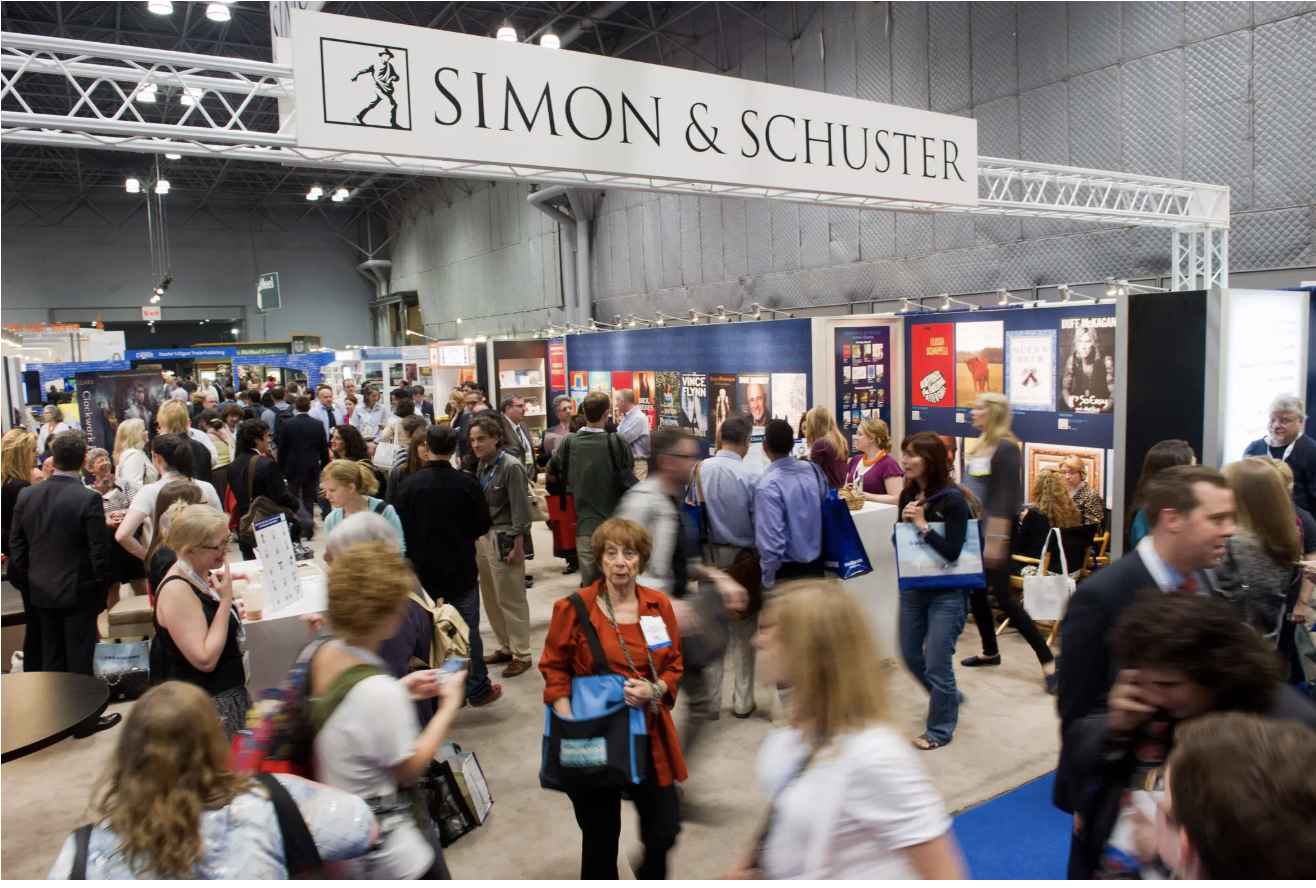
The Simon & Schuster booth, crowded with convention attendees, at BEA in the 1990s.
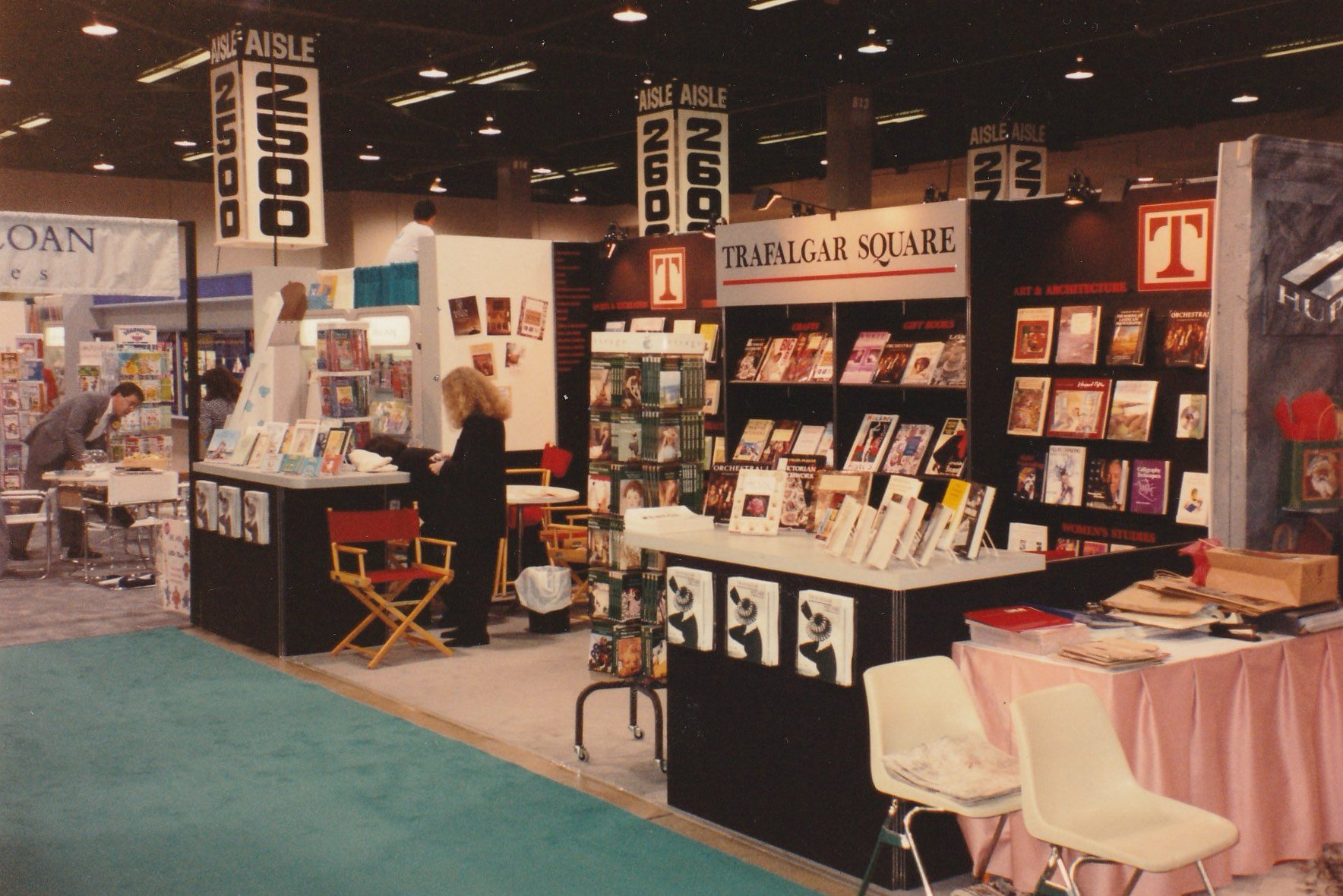
The Trafalgar Square Publishing booth at BEA, for comparison!
There were also posters, canvas tote bags, tee-shirts, and other “merch” for the taking at the major publishers’ booths. As I mentioned, the freebies were intended for the booksellers, at the time what we called “the blue badges” since all booksellers wore a badge with a blue band. The blue badges were the important attendees back then. They were the people there to place book orders. This was before consolidated ordering from Ingram Wholesale or Baker & Taylor was the norm. Small bookshop owners visited publisher booths and placed orders at special convention discounts. They had the opportunity to look at the books displayed. We had a large, three-part NCR (no carbon required) order form. When a booksellers came by and said, “I want to place an order,” one of us would dive for the forms, sit down at a table with the book buyer, and begin writing an order. It was hand bookselling; a buyer would say, “Let me see that book on container gardening.” I’d jump up and grab the book. The best thing was when a buyer would say, “I’ll take three copies!” Back in those days Trafalgar Square Books would take enough orders at the BEA to pay for the convention costs that included the booth space, employee travel, hotels and food for six or seven employees.
Booth set-up took hours and saw a fair share of squabbing amongst the staff about what books went where and which titles would get front counter placement. Over the show’s four days books were known to find themselves in different places due to some subtle adjustments!
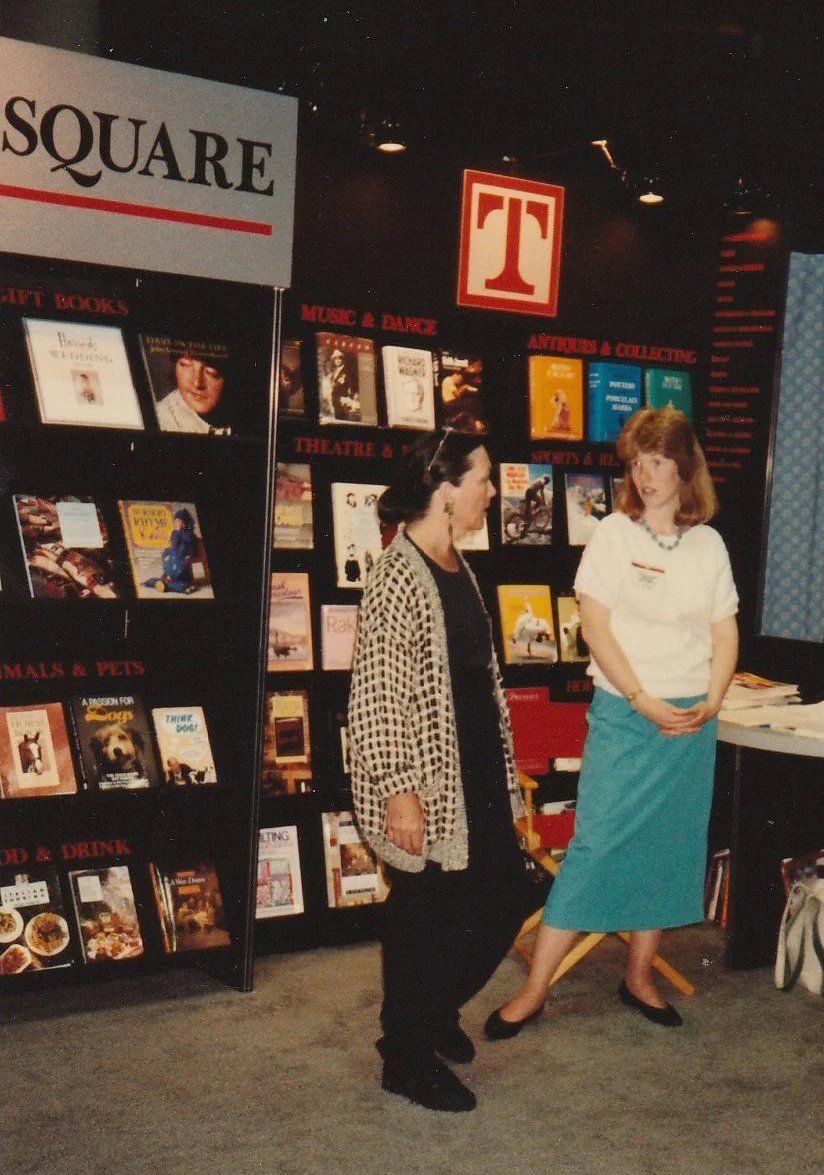
At work in the booth, after setup had been debated and (finally) completed!
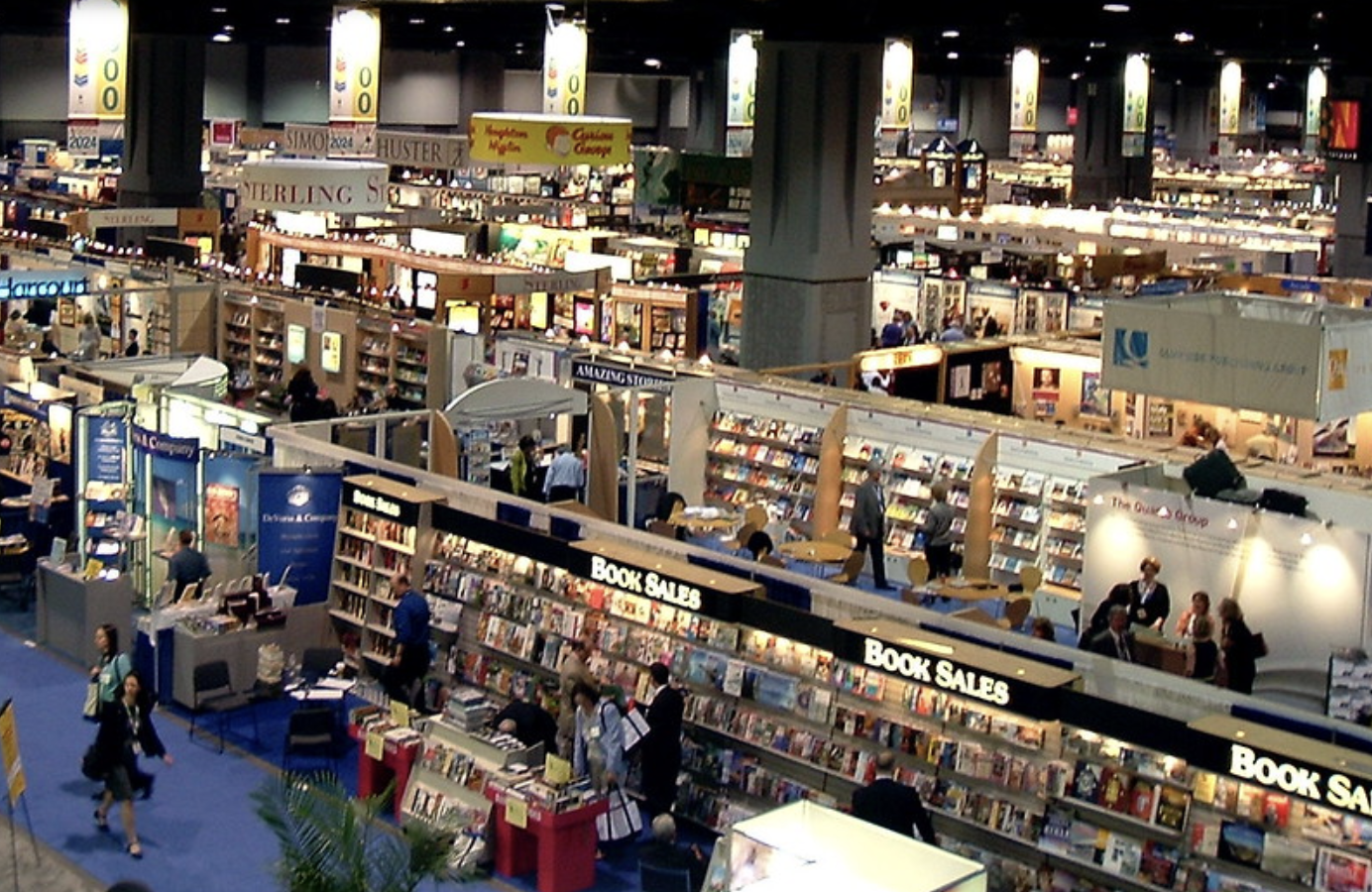
The BEA convention floor, from above, is a book lover’s dreamscape.
The passing parade of celebrities was memorable. Hollywood icons with new biographies or movie tie-ins, politicians, and NYT bestselling authors: Oprah Winfrey, Ron Howard, Margaret Thatcher, Michael Crichton, and Maya Angelou to name only a few, and don’t forget Fabio, the romance cover icon! He was at BEA with his famous golden locks, year after year. There was also the special “book band,” the aptly named Rock Bottom Remainders, composed of best-selling authors Dave Barry, Stephen King, Amy Tan, Sam Barry, Ridley Pearson, Scott Turow, Roy Blount, Jr., and many others over the band’s 32-year history. It was special to see them perform in 1992 at the Anaheim, CA, show with Bruce Springsteen.
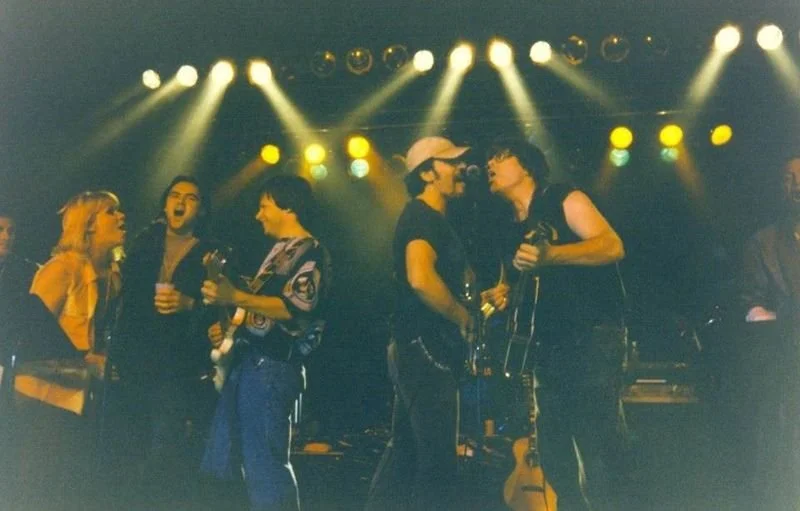
The Rock Bottom Remainders playing at BEA with a goateed Bruce Springsteen in Anaheim, CA.
Speaking of Anaheim, it was the first and only time I’ve been to a Disney park. We spent a couple evenings at Disneyland—I will never go on a roller coaster again! Other years the show visited Miami, and we stayed in an Art Deco hotel on the strip in South Beach. The show was in Chicago many years, and that city has become one of my favorite places to visit, thanks to the BEA. Each year it was there, I took an extra day to visit the Art Institute of Chicago, the Shedd Aquarium, and the Oppenheimer Gallery filled with natural history art, including original John James Audubon works. There were also the late nights at blues clubs like Buddy Guy’s. In NYC, I went to the Met, had great meals in Greenwich Village, and walked the High Line.
All the American Bookseller conventions were great experiences over the years. They were opportunities for a “young me” to learn to negotiate large cities and interact with book people from around the world. They were major growth opportunities, which eventually led to me going overseas to the London and Frankfurt Book Fairs, where I began to negotiate foreign rights deals.
The BEA ceased in 2021, no doubt irreparably harmed by COVID. It had already become a shadow of its former self. Independent booksellers were scarce in a book world dominated by ruthless Amazon. It took a smaller portion of the Javits Center each year. I don’t even remember the last time I attended. In an effort to breathe some life into the event, the ABA added a consumer component called “Book Con,” but never did the “big show” of my days in traditional publishing recover. As of this writing, Book Con does continue with a two-day consumer show in the month of April in New York.
—Martha